French short stories for beginners: read and listen, A1 to A2
Reading is where a beginner's French grows fastest — but only if the text is at your level. Open a French novel at A1 and you will spend an hour with a dictionary on one page. Open a story written for your level and you will read for the story, which is the whole point.
Here is how to choose French short stories as a beginner, how to read them so the words stay, and where to start.
Why graded stories work
A graded story is written for one level. At A1 that means short sentences, the present tense, everyday words, and a lot of repetition. Almost every word is within reach, and the few new ones are easy to guess from the story.
That is the sweet spot for learning: you understand enough to enjoy it, and you meet just enough new French to grow. Researchers call it comprehensible input. Readers call it a good book.
Stories also give you something word lists never will: words in context. You don't learn voler from a list. You learn it because a boy wants wings to fly.
Read and listen at the same time
All the A1 and A2 stories on the Parisly stories shelf are narrated. Listening while you read is one of the best habits a beginner can build:
- your eyes help your ears recognise words they would miss on their own;
- you hear how written French actually sounds — all those silent letters;
- you pick up the rhythm and intonation of whole sentences.
And when you are stuck, the English is there alongside, and you can hover any French word to see its meaning.
How to read one story
- Look at the title and the picture. Guess what will happen.
- Listen and read, without stopping. Get the story, not every word.
- Read again, slowly. Now hover the words you didn't know. Note five that you want to keep.
- Check the English only for the sentences you really can't crack. If you read the whole translation first, you are reading in English.
- Do the guided lesson. A few questions on the story, and the words worth knowing.
- Read it out loud. One last time, with the narrator if you like. It is excellent pronunciation practice.
Twenty minutes, one story. Do it four times a week and your reading will change in a month.
Where to start at A1
At A1 you know a few hundred words and simple sentences in the present. These stories are written for exactly that:
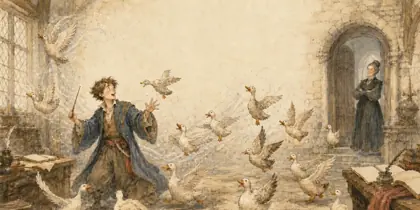
- Ailes magiques — Matthieu, a young wizard, tries a big spell to get wings. It doesn't go to plan. This one is free, and you don't need an account.
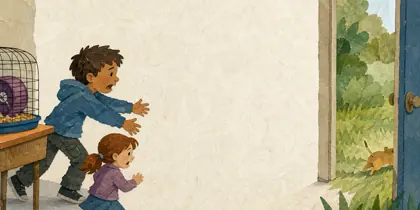
- La Queue du hamster
- Le Voyage en camping
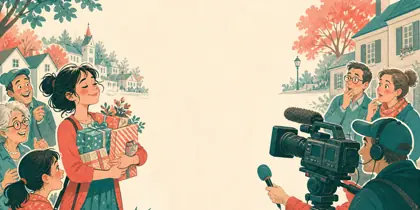
- La Gagnante malchanceuse
- Le Sport de la lecture
- Dix ans d'absence
See every A1 story on French stories for A1.
Moving up to A2
At A2 you can follow simple everyday situations and you start meeting the past tenses. The stories get a little longer and the plots a little twistier:
- J'adore les axolotls
- La Clé perdue
- L'Aide de minuit
- L'Évasion sur l'île
- L'Affaire parfaite
- Le Pays de la pluie éternelle
All of them: French stories for A2. The shelf keeps going up through B1, B2, C1 and C2, so you never run out.
How do I know a story is right for me?
A simple test: read the first paragraph. If you understand most of it without help and there are only two or three words you don't know, it is your level. If you need the dictionary for every line, go down a level. If it feels effortless, go up.
A useful rule: start one level below where you think you are. Easy reading builds speed and confidence, and speed is what lets you read enough to improve.
Mistakes beginners make
- Starting too hard. A classic novel at A2 is not brave, it is discouraging. Graded first, literature later.
- Looking up every word. You will lose the story. Guess from context, check only the words that block you.
- Reading the English first. Then your brain has the meaning already and stops working on the French.
- Reading silently only. Listen and read together, and read aloud sometimes.
- Reading once. A second reading of the same story is where words move into memory.
What comes next
Once stories feel comfortable, add real spoken French: short film scenes, or French songs with the lyrics line by line. Every shelf has free lessons, and no account is needed to start. Not sure of your level? Let Parisly suggest one.
Questions learners ask
Are these French stories for beginners free?
Every shelf has free lessons, including the A1 story Ailes magiques, and you can open it without an account.
Do the stories come with audio?
Yes — every A1 and A2 story is narrated, so you can listen while you read.
Is there an English translation?
Yes, the English is there alongside the French, and you can hover any French word to see it in English. Use it for the sentences you are stuck on, not for the whole story.
How many stories should I read?
Little and often: three or four short stories a week will do more than one long session.
Can teachers send these stories to students?
Yes. Each story can be sent to a student in one click, with its homework. See Parisly for teachers.